July 13-15, 2002

Saturday, July 13, 2002
Tuesday, January 1, 2002
Wireless World
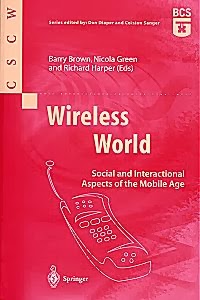
Wireless world: Social and interactional aspects of the
mobile age
Barry Brown, Nicola Green and Richard Harper (Eds.)
A reviewer from Amazon.com noted:
Published in 2001, this book is a collection of twenty-one papers submitted by research-oriented writers from both the academic and corporate worlds.
The papers discuss aspects of mobile voice and data communication adoption and use and the impact of this technology on various societies. Some of the papers compare the affects of mobile communications technology between cultures and nations including Scandinavia, Asia, the USA and other European nations.
Some papers relied only on the authors observations to support their thesis, and others used qualitative or quantitative consumer surveys, or statistical analysis of other published numerical data. Most were very analytic and written in the tone of professional, peer reviewed academic technical journal articles complete with extensive bibliographic references. It seems the authors were searching to construct some new models of social and cultural interaction based on the use of mobile technologies.
There are some thought-provoking analytic studies documented here, and good bibliographic references. If this is what you are looking for I feel that these papers would rank among the vanguard of social and cultural research in mobile telephony at the time.
Citation:
Barry Brown, Nicola Green and Richard Harper (Eds.)
A reviewer from Amazon.com noted:
Published in 2001, this book is a collection of twenty-one papers submitted by research-oriented writers from both the academic and corporate worlds.
The papers discuss aspects of mobile voice and data communication adoption and use and the impact of this technology on various societies. Some of the papers compare the affects of mobile communications technology between cultures and nations including Scandinavia, Asia, the USA and other European nations.
Some papers relied only on the authors observations to support their thesis, and others used qualitative or quantitative consumer surveys, or statistical analysis of other published numerical data. Most were very analytic and written in the tone of professional, peer reviewed academic technical journal articles complete with extensive bibliographic references. It seems the authors were searching to construct some new models of social and cultural interaction based on the use of mobile technologies.
There are some thought-provoking analytic studies documented here, and good bibliographic references. If this is what you are looking for I feel that these papers would rank among the vanguard of social and cultural research in mobile telephony at the time.
Citation:
Brown, B., Green, N., & Harper, R. (Eds.) (2002).
Wireless world: Social and interactional aspects of the mobile age. London, UK:
Springer.

Perpetual contact

Perpetual Contact: Mobile Communication, Private Talk, Public Performance
James E. Katz and Mark Aakhus (Eds.)
A reviewer from Amazon.com noted:
Published in 2001, this book is a collection of twenty-one papers submitted by research-oriented writers from both the academic and corporate worlds.
The papers discuss aspects of mobile voice and data communication adoption and use and the impact of this technology on various societies. Some of the papers compare the affects of mobile communications technology between cultures and nations including Scandinavia, Asia, the USA and other European nations.
Some papers relied only on the authors observations to support their thesis, and others used qualitative or quantitative consumer surveys, or statistical analysis of other published numerical data. Most were very analytic and written in the tone of professional, peer reviewed academic technical journal articles complete with extensive bibliographic references. It seems the authors were searching to construct some new models of social and cultural interaction based on the use of mobile technologies.
There are some thought-provoking analytic studies documented here, and good bibliographic references. If this is what you are looking for I feel that these papers would rank among the vanguard of social and cultural research in mobile telephony at the time.
Citation:
Katz, J. E., & Aakhus, M. (Eds.) (2002). Perpetual
contact: Mobile communication, private talk, public performance. Cambridge, UK:
Cambridge University Press.
Friday, January 1, 1999
Connections: Social and cultural studies of the telephone in American life

Connections: Social and Cultural Studies of the Telephone in American Life
James E. Katz
Robert Pike at Queens University notes that:
No technology is more ubiquitous than the telephone, and none less examined. Rutgers communications scholar James Katz introduces his book with this observation, though recognizing that it applies less to studies of the social history of the phone than to its contemporary social use and users. Thus, the phone has been overshadowed by social research on the more glamorous technologies, notably the Internet. Yet, cell phone and pager ownership increases rapidly ( so rapidly that in some countries like Finland pubic phone booths are being removed ); phone companies offer a host of add- on services; and our right to privacy is constantly invaded by unwanted phone intruders. Such are the grist for Katz’s mill.
Katz offers here a series of eleven chapters, most previously published and some co-authored, which empirically analyze critical social questions pertaining to wireless phone communications, and to organizational change in the U.S. telephone business. The greatest strength of the book lies in the fact that most of these questions have never before been seriously asked. Thus, the first of the book’s four sections focuses primary on cell phone ownership and use, and public attitudes towards voice mail and phone answering services. The second section examines a variety of ethical issues surrounding privacy and caller I.D., provides empirical analyses of unlisted subscribers, and explores the extent of obscene phone calls as well as the socio-economic and racial characteristics of their recipients. Section three is devoted to studies of demand for U.S. phone services and to local phone markets. Finally, Katz reaffirms a powerful anti-determinist stance by providing numerous illustrations of how people may creatively use phone technologies in ways never foreseen by their developers.
The full review can be found at http://www.arts.ualberta.ca/cjscopy/reviews/phone.html.
Citation:
Katz, J. E. (1999). Connections: Social and cultural studies
of the telephone in American life. New Brunswick, NJ: Transaction.
Subscribe to:
Posts (Atom)