Society for the Social Study of Mobile Communications


The Society for the Social Study of Mobile Communication (SSSMC) is intended to facilitate the international advancement of cross-disciplinary mobile communication studies. It is intended to serve as a resource and to support a network of scholarly research as to the social consequences of mobile communication.


Friday, June 24, 2016

CFP: Computational Social Science in the Age of Big Data

Call for Book Chapters: Computational Social Science in the Age of Big Data
Deadline: 30 June 2016

1.    Working Title of Book

Computational Social Science in the Age of Big Data. Concepts, Methodologies, Tools, and Applications

2.    Publisher

Herbert von Halem Verlag (Cologne, Germany), in Neue Schriften zur Online Forschung of the German Society for Online Research (DGOF); expected publication in 2017.

3.    Editorial Board
Cathleen M. Stuetzer (JGU Mainz, Institute for Sociology)
Martin Welker (HMKW Cologne, Journalism and Communication Science)
Marc Egger, INSIUS Berlin

4.   Description and Purpose of the Book
In the digital age the exponential growth in the amount of data brings out new forms of social science research by using computational techniques to handle and manage big data sources. The book will demonstrate how data analysts both from academia and business analyze large and complex masses of data by taking a multidisciplinary approach. It will uncover cutting-edge analysis techniques and methods for searching and using large data sets within different disciplines like sociology, information science, communication science, health, education, political science, psychology, economics, and other fields. The rapid emergence of computational social science as new discipline shows the potential need to discuss innovative approaches and new techniques to understand our complex social system (Lazer et al. 2009). Data scientists, researchers, as well as professional data analysts from different fields look for theoretical concepts, methodological approaches, instruments, and tools to make large-scale and complex data available for research on human behavior (Alvarez 2016; CioffiRevilla 2010; Conte et al. 2012). The purpose of the book is to summarize the current state of knowledge about meaning, development, and uses of computational social science in the context of big data. The book will bring together the status quo of theoretical background, concepts, methodological approaches, instruments, tools as well as applications and empirical-based research studies. The audience of this book are the academic as well as commercial sector researchers, commercials, students, and teachers who have begun using big data to examine human behavior online.

5.   Submission procedure for chapter proposals and Notification

Each chapter should contain a critical review of literature on the topic of the chapter, summarize and evaluate what is known about it, report research findings, identify important gaps of knowledge as well as make suggestions for future research.

A subset of possible chapter topics include:

  • Concepts and Theoretical aspects
  • Methodology
  • Analytical Instruments & Techniques
  • Tools & Applications
  • Big Data Analytics
  • Business Analytics
  • Data Science
  • Behavioral Science
  • Data Mining
  • Data Visualization
  • Data Analysis
  • Data Sharing
  • Data Storage
  • Information Retrieval Methods
  • Security and Privacy issues
  • Case Studies


Submissions should be in German or in English and must include the title, author(s) name, affiliation(s), e-mail address(es), tel/fax numbers, and e-mail address, postal address(es), and abstract on the first page. In the case of multiple authors, all names, addresses, etc. must accompany the submission and a single author must be identified as the primary point of contact.

Submissions must be sent as an e-mail attachment to Cathleen Stuetzer using the e-mail address office@dgof.de and/or cstuetze@uni-mainz.de.

Chapter Proposal Length: max. 3 pages, Format: Adobe PDF

All chapter proposals will be evaluated by a committee of experts before author(s) are being invited to submit the full book chapter. Papers will be selected based on their originality, relevance, and clarity of presentation. Authors should certify that their papers represents substantially new previously unpublished work.

Chapters must not have been published elsewhere. Unpublished conference presentations are acceptable. Published conference presentations (e.g. in a proceedings volume) may be acceptable if the full copyright can be transferred. If submitting a published conference presentation, the author(s) must provide proof that the article's full copyright can be transferred.

6.  Important Dates and Anticipated Deadlines for Chapters
Chapter Proposal Submission Deadline: June 30, 2016
Notification of Chapter Proposal Acceptance/Rejection: August 1, 2016
Final Book Chapter Submission Deadline (Revised Version Due): December 15, 2016
Final Notification of Acceptance/Rejection: April 1, 2017
Final Camera-Ready Version Deadline: June 30, 2017
Publication Date (tentative): Summer 2017
The chapter proposal should be sent via email to office@dgof.de no later than June 30, 2016. These papers will be examined in an academic review process by a committee of experts. A confirmation of receipt of the submission will be sent within three days, and if you do not receive the confirmation please resend the email and/or contact Cathleen Stuetzer (cstuetze@uni-mainz.de).

Notification regarding the status of each proposal will be sent by August 1, 2016 to all those who submitted a chapter proposal. At that time authors whose chapter proposals have been accepted will also be e-mailed guidelines regarding full book chapter preparation.

The final book chapter deadline is December 15, 2016. Following receipt, full chapters will be sent out for double-blind review. The editors will make the final decision regarding final acceptance of each book chapter until April 1, 2017. All chapters with revision requests (if necessary) need to be completed by June 30, 2017.

7.    Inquiries should be directed to

Dr. Cathleen M. Stuetzer

Board Member of the German Society for Online Research (DGOF)
Internet: www.dgof.de, Email (DGOF-Office): office@dgof.de

 ---
 Johannes Gutenberg University Mainz, Institute for Sociology
 Department of Social Network Research and Sociology of the Family
 Office: Jakob-Welder-Weg 12, Georg Forster-Gebäude
 Room: 03.443 (GFG), D-55099 Mainz, Germany
 Phone: +49 6131 39 29397
 Email: cstuetze@uni-mainz.de

8.    Further information are available here

Website: https://sites.google.com/site/cfpcomputationalsocialsciences

Publisher: http://www.halem-verlag.de/2015/neue-schriften-zur-online-forschung

Additional Information: www.dgof.de

9.    References
Alvarez, R. M. 2016. Computational Social Science: Cambridge University Press.
CioffiRevilla, C. 2010. Computational social science. Wiley Interdisciplinary Reviews: Computational Statistics (2), S. 259-271.
Conte, R., N. Gilbert, G. Bonelli, C. Cioffi-Revilla, G. Deffuant, J. Kertesz, V. Loreto, S. Moat, J. P. Nadal, A. Sanchez, A. Nowak, A. Flache, M. San Miguel, und D. Helbing. 2012. Manifesto of computational social science. The European Physical Journal Special Topics (214), S. 325-346.
Lazer, D., A. Pentland, L. Adamic, S. Aral, A. L. Barabasi, D. Brewer, N. Christakis, N. Contractor, J. Fowler, M. Gutmann, T. Jebara, G. King, M. Macy, D. Roy, und M. Van Alstyne. 2009. Life in the network: the coming age of computational social science. Science (New York, N.Y.) (323), S. 721-723.


CFP: Social Media and Political Participation

CFP: Full manuscript for Special Issue "Social Media and Political Participation" in Social Sciences
(Edited by Terri L. Towner, Oakland University)

Manuscript Deadline:  Full manuscripts due by June 30, 2016.

Social media’s role in politics, campaigning, and elections has been the focus of scholarly research for over a decade. Scholars have examined how political candidates, parties, and citizens use social media during campaigns as well as how social media influences citizens’ political attitudes and behaviors. Despite extensive study, the empirical literature linking social media use and attention, particularly Facebook, Twitter, and YouTube, to political participation is mixed and thus, inconclusive. Some research suggests that social media facilitates and promotes political and civic participation whereas other research does not. Therefore, this special issue seeks to further clarify the link between social media and political engagement. This call is particularly interested in research that examines relatively understudied social media platforms, such as Tumblr, Instagram, Flickr, Pinterest, and SnapChat. In addition, this call encourages submissions that examine many forms of political participation, as this concept can be a multidimensional activity including voting, protesting, marching, blogging, tweeting, volunteering, sharing online content, emailing, and more.

Submissions are sought from a broad array of disciplines, perspectives, and nations, representing a diverse collection of topics, including, but not limited to:
  • Social media and political participation
  • Social media and election outcomes
  • Social media and political attitudes
  • Social media as a campaign tool
  • Social media and mass media, particularly the role of social media in reporting political news
  • Social media and interest/advocacy groups
  • Social media and social movements
  • Social media and government/e-government
  • Social media and democracy
  • Social media users and their characteristics in the context of political participation


If you are interested in submitting, please see the website for more information and submission instructions: http://www.mdpi.com/journal/socsci/special_issues/political_participation

Tuesday, June 7, 2016

CPF: When the Virtual Becomes Real: Gender Violence and Social, Mobile, and Interactive Media

Call for Chapters and Proposals

Working Title: When the Virtual Becomes Real: Gender Violence and Social, Mobile, and Interactive Media

Editors

Lisa Cuklanz, Ph.D.
Communication Department,
Boston College
lisa.cuklanz@bc.edu

Heather McIntosh, Ph.D.
Mass Media Department,
Minnesota State University, Mankato
heather.mcintosh@mnsu.edu

Submission Deadline: October 15, 2016

Overview

Popular reactions to gender violence online parallel the early reactions to sexual harrassment and domestic violence in that the violence is downplayed, denied, or dimissed. "It's just a joke," they say. "It's harmless," they say. "Those who cannot handle it should leave," they say. They even claim free speech as their right to continue.

For the person experiencing the violence, however, it is very real. Online, it shows up as e-mail, comments, blogs, fake social networking profiles, search results bombing, doxxing, and revenge porn. Offline, it results in defamation, SWATting, and physical threats. And yet, the attackers fueling these onslaughts often remain anonymous and unknown, making perpetrator identification and law enforcement challenging.

This edited volume seeks to address the intersections of gender violence and social, mobile, and interactive media in order to further scholarly discussion of these issues. It seeks to question how online environments force us to rethink the questions of gender violence.

Some possible topics for this volume include -- but are not limited to -- the following:
  • News framing and other media coverage
  • Organizations' uses of social media and other tools to raise awareness
  • Social networks, their policies, and their responses
  • Communities, apps, and other tools that provide support
  • Hashtag campaigns, their contributors, and their hijacking
  • Representations in popular entertainment media and audience reactions
  • Sociocultural intersectionalities of online identities
  • Types of gender violence that occur and tools used to perpetuate them


Submission Guidelines

Chapter submissions must be original works not under review or previously published elsewhere. They should run 6,000-8,000 words, including title, abstract, and references. Along with your submission, attach a current CV. Use .pdf, .doc, .rtf, or other accessible file format for your attachment. Citation style should be consistent throughout, such as APA, MLA, or Chicago. Send your submission to lisa.cuklanz@bc.edu or heather.mcintosh@mnsu.edu by October 15, 2016.

While complete chapters are preferred, we also will consider proposals, which should run 1,000 words and include a working bibliography and title. Along with your submission, attach a current CV. Send your chapter proposal to lisa.cuklanz@bc.edu or heather.mcintosh@mnsu.edu by October 15, 2016.

Projected Timetable

While we have a publisher interested in this project, please note this timetable may change.

October 15, 2016 -- Proposals Due
January 15, 2017 -- Feedback
June 15, 2017 -- Chapter Drafts Due
July 15, 2017 -- Chapter Feedback
October 15, 2017 -- Revisions Due
December 15, 2017 -- Submit to Publisher

If you have any questions, please send them to Lisa Cuklanz at lisa.cuklanz@bc.edu or Heather McIntosh at heather.mcintosh@mnsu.edu.

Wednesday, May 11, 2016

CFP: Social Media Technology Conference & Workshop

CFP: Social Media Technology Conference & Workshop
October 6-7, 2016
Howard University Washington, D.C.
http://socialmediatechnologyconference.com/
@smtechconf

Social Media and Voices in the Margins
The 6th Annual Social Media Technology Conference & Workshop is a two-day
intensive conference combining panel discussions, posters sessions and
hands-on workshops designed to enlighten attendees about new scholarship,
professional practices and pedagogical approaches to teaching. This year’s
theme focuses on dissecting how power and difference force or provide an
opportunity for social media to be used by those who may be considered
marginalized in U.S. society or within other countries. The goal is to
bring scholars and professionals together to share their perspectives on
how social media are utilized by various individuals, groups, cultures or
organizations to bring their voice, influence and impact on societies.
Interested individuals can send in papers, workshop themes, panels and
poster proposals that address a myriad of topics, including, but not
limited to, the following:


  • Social media and Congregation
  • Social media and Geographies
  • Social media and Acts of Violence
  • Social media and Racism
  • Social media and Sexism
  • Social media and the LGBTQIA Community
  • Social media and Inner City Youth
  • Social media and Police Violence
  • Social media and #BlackLivesMatter
  • Social media and the Educationally and/or Economically Disadvantaged
  • Social media and Diverse Media Messaging
  • Social media and Theology
  • Social media and Lifestyles
  • Social media and Ageism
  • Social Media and the Global South
  • Social Media and Intersectionality

Paper and Poster Submissions
Respondents should submit a 3-5 page proposal that includes an overview of
the study as well as research design that includes brief review of the
literature and methodology. All respondents in this category should clearly
identify the submission type on their proposal and send the proposal
through EasyChair by June 30, 2016 at the following site:
https://easychair.org/conferences/?conf=smtc2016. In addition to the
proposal, a file should be uploaded with a 100-word abstract of the
proposed paper or poster as well as a 100-word biography for each author.
Presenters will be notified by mid-July of the status of their submissions
and should register to attend the conference by September 1, 2016.

Panel Submissions
Respondents should submit a 3-5 page proposal addressing the purpose of the
panel and specific issue(s) to be covered. The proposal should include a
list of the confirmed guests or those who will be solicited for the panel
as well as their brief biographies. All respondents in this category should
send the proposal through EasyChair by June 30, 2016 at the following site:
https://easychair.org/conferences/?conf=smtc2016. In addition to the
proposal, a file should be uploaded with a 100-word description of the
proposed panel as well as a 100-word biography for each presenter.
Presenters will be notified by mid-July of the status of their acceptance
and should register to attend the conference by September 1, 2016.

Workshop Submissions
Respondents should submit a 3-5 page proposal addressing the purpose of the
workshop, details about the technology, social media trend or tool to be
explored and what attendees will gain from attending it. Workshops are
scheduled for 90 minutes, so content should be sufficient enough to fill
the timeslot. If applicable, the proposal should include a list of the
confirmed guests or those who will be solicited for the workshops as well
as their brief biographies. All respondents in this category should send
the proposal through EasyChair by June 30, 2016 at the following site:
https://easychair.org/conferences/?conf=smtc2016. In addition to the
proposal, a file should be uploaded with a 100-word description of the
proposed workshop as well as a 100-word biography accompanied by a
photograph for each workshop presenter. Presenters will be notified by
mid-July of the status of their acceptance and should register to attend
the conference by September 1, 2016.

Cost
The registration fee for the two-day conference is $125. Students pay the
reduced rate of $60. All presenters, attendees and workshop participants
are required to pay the conference fee.

Contacts
Dr. Michael Austin
Howard University
michael.austin@howard.edu

Professor Ingrid Sturgis
Howard University
isturgis@howard.edu

Dr. Kehbuma Langmia
Howard University
klangmia@howard.edu

Dr. Tia C. M. Tyree
Howard University
ttyree@howard.edu

Tuesday, May 10, 2016

Steve Jones Internet Research Lecture features Leopoldina Fortunati

Steve Jones Internet Research Lecture features Leopoldina Fortunati

Hilton Fukuoka Sea Hawk
June 14, 2016
Fukuoka, Japan

The 2016 Steve Jones Internet Research Lecture features Leopoldina Fortunati (University of Udine, Italy), at 12 pm, on June 14, 2016, in Hilton Fukuoka Sea Hawk, International Communication Association’s 66th Annual Conference, in Fukuoka, Japan.

The title of Fortunati’s lecture is “Feminism, labor and the mechanization of everyday life.”  In the lecture, Fortunati will adopt a political economy approach to examine the issue of machines diffusion in everyday life, which connects machines with labor, value production and struggles/resistance, especially by women, against the present organization and division of labor.

Fortunati will address the social and political role of machines in society, as well as social robots, which can be considered in many ways the next new media. Some social robots built in recent years in many laboratories are ready to be launched on the market and more generally placed in society. But the conceptual tools to handle this last mile to go still need to be fully developed. When an object of such technological complexity and with such rhetorical power, like robots are, is no longer used only by niches of innovators or users (such as autistic) but is proposed as a good of mass consumption, a series of problems, new themes and strategies comes into the spotlight.


This event is co-sponsored by the Carl Couch Center for Social and Internet Research (www.cccsir.com), University of Illinois, Chicago, and the International Communication Association.  For more information about this event, please contact Shing-Ling Sarina Chen, sarina.chen@uni.edu.

Thursday, April 28, 2016

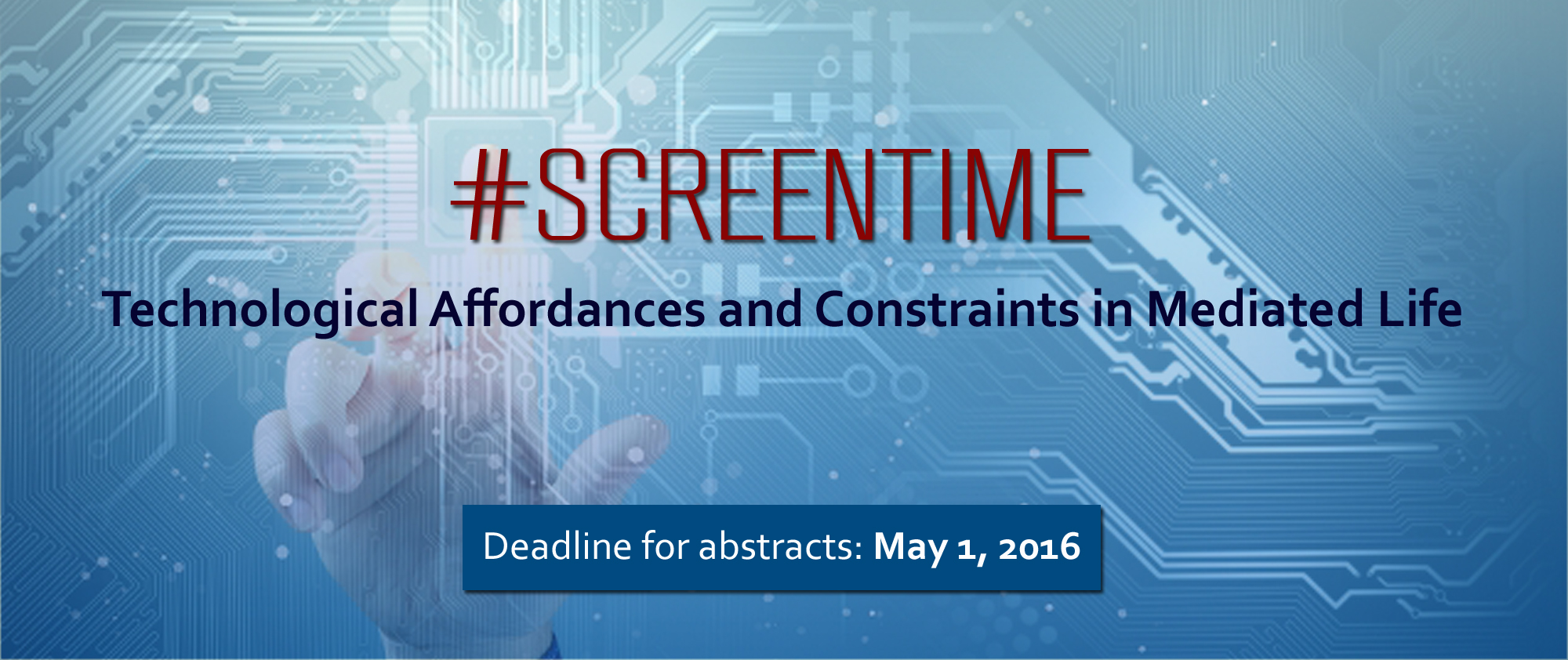
#Screentime 2016 - Technological Affordances and Constraints in Mediated Life

#Screentime 2016 - Technological Affordances and Constraints in Mediated Life


The graduate students of Boston University’s Division of Emerging Media Studies invite abstracts for their second annual Conference on Emerging Media.

#Screentime aims to explore the social, emotional, and civic implications of today’s media landscape. Social forces and technological elements are driving changes in this developing field of study.This conference is an opportunity to bridge diverse perspectives on the roles of users and technology in new media, and will lay the groundwork for future research.

Topics

Emerging Media Studies is an inherently interdisciplinary field; we welcome abstracts from a variety of perspectives and disciplines on a range of topics, including but not limited to:

  • Civility, sub-cultures, and online discourse
  • Uses and effects of mobile communication technologies Digital distribution and industry disruption
  • Data mining on social networks
  • Emerging technologies’ effects on users
  • Video games and virtual worlds
  • Digital communication and public health

The conference is free of charge to both presenters and attendees.This conference is aimed at graduate students to showcase their research, and as an opportunity to network with peers.

Important Dates

Abstract Submission - May 1, 2016
Acceptance Notification - June 1, 2016
Registration Deadline - TBA
Conference - June 23, 2016

Venue

10 Buick Street – 18th Floor, Student Village 1 – Boston, MA 02215

Submission Instructions

Abstracts should be no more than 300 words. Papers will be peer reviewed.
E-mail your submissions to demsconf@bu.edu

Please include your name and institutional affiliation (department/university), program and year of study, research focus/interests, and contact information (email and phone number).

Applicants will be notified of their acceptance on a rolling basis no later than June 1st, 2016.


Thursday, April 21, 2016

CFP: 9th International Conference on ICT, Society and Human Beings 2016


CALL FOR PAPERS ICT 2016: 9th International Conference on ICT, Society and Human Beings 2016
Funchal, Madeira, Portugal, 1 - 3 July 2016
(http://www.ict-conf.org/)
Part of the Multi Conference on Computer Science and Information Systems (MCCSIS 2016)
Funchal, Madeira, Portugal, 1 - 4 July 2016
(http://www.mccsis.org)

Keynote Speaker (confirmed):
Professor emerita Gunilla Bradley, Informatics, School of ICT, Royal Institute of Technology (KTH), Stockholm, Sweden

Conference Scope
The effects of ICT on human beings as well as the interaction between ICT, individuals, and society are all within the focus of this conference. Both analyses of interactions and effects are important. Changes in behaviour, perspectives, values, competencies, human and psychological aspects and feelings are all of interest. Reflections on past, present, and future challenges - especially planning to handle the future - are encouraged.
The conference pays attention to societal changes, global and more local organisational and institutional changes, changes in values and in lifestyles, as well as individual cognitive effects and changes, motivational and emotional changes. It also appeals to solution-building in terms of desirable goals and actions for reaching a Good Information Society.
In general all types of research strategies are encouraged, and especially cross-disciplinary and multi-disciplinary studies. Case studies, broader empirical field studies, theoretical analyses, cross-cultural studies, scenarios, ethnographic studies, epistemological analyses may all be presented. For more details please check http://www.ict-conf.org/call-for-papers .

Paper Submission
This is a blind peer-reviewed conference. Authors are invited to submit their papers in English through the conference submission system by May 13, 2016. Submissions must be original and should not have been published previously.

Important Dates:
  • Submission Deadline (last call): 13 May 2016
  • Notification to Authors (last call): 3 June 2016
  • Final Camera-Ready Submission and Early Registration (last call): Until 17 June2016
  • Late Registration (last call): After 17 June 2016

Paper Publication
The papers will be published in book and electronic format with ISBN, will be made available through the Digital Library available at http://www.iadisportal.org/digital-library/showsearch.
The conference proceedings will be submitted for indexation by IET's INSPEC, Elsevier, EI Compendex, Scopus, Thomson Reuters Web of Science, EBSCO and other important indexing services.
The best papers will be selected for publishing as extended versions in the IADIS International Journal on WWW/Internet (ISSN: 1645-7641) and also in journals from INDERSCIENCE Publishers.

Conference Contact:
E-mail: secretariat@ict-conf.org
Web site: http://www.ict-conf.org/

Organized by: International Association for Development of the Information Society

Registered participants in the ICT, Society and Human Beings conference may attend the other conferences part of MCCSIS 2016 free of charge.